

Owning a rental property is a lot like owning a car: it can carry you a long way, but only if you check under the hood once in a while. Many owners set rent, collect the checks, and assume everything is fine. But markets shift, expenses creep up, and a property that made financial sense five years ago may not be performing as well today.
Understanding your rental property's performance goes beyond looking at how much rent you collect each month. You also need to consider its current market value, operating expenses, cash flow, tenant retention, and potential for appreciation.
Here are the key takeaways on how to evaluate a real estate investment and determine whether the rental property is still working toward your financial goals.
- Use comparable sales and local market data to assess your property’s current value.
- Look beyond gross rent to account for expenses, vacancy, and major repairs.
- Track rental demand, neighborhood growth, and competing inventory to evaluate future potential.
- Prioritize maintenance and tenant retention to protect income and property conditions.
- Compare rental income, equity, ongoing costs, and selling expenses when deciding whether to hold or sell.
Now let’s dive a little deeper into the specifics.
Table of Contents:
- Determine Your Rental Property’s Current Market Value
- Calculate Your Rental Property’s Cash Flow and Return on Investment
- Compare Rental Rates and Evaluate Local Market Demand
- Review Maintenance Costs and Plan for Capital Improvements
- Evaluate Tenant Retention and Vacancy Costs
- Monitor Local Market Conditions and Future Appreciation
- Evaluate Property Management and Investment Protection
- Compare the Financial Benefits of Holding vs. Selling
- Track Your Rental Property's Long-Term Investment Performance
- Frequently Asked Questions
Determine Your Rental Property’s Current Market Value
Start with what your property is worth today, not what you paid for it. The most reliable starting point is comparable properties, or “comps”. Look at recently sold homes in the same neighborhood with similar square footage, bedroom and bathroom counts, age, and features.
Adjust for meaningful differences such as:
- Location: School districts, neighborhood desirability, walkability, and proximity to jobs and amenities can influence property values.
- Property condition: Updated kitchens, renovated bathrooms, new roofs, and well-maintained systems can increase market appeal.
- Comparable sales: Focus on recently closed sales rather than asking prices, adjusting for meaningful differences between properties.
- Market trends: Review local home price trends, days on market, and available inventory to understand whether demand is strengthening or slowing.
Calculate Your Rental Property’s Cash Flow and Return on Investment
Collecting rent doesn't necessarily mean your property is profitable. What matters is how much income remains after accounting for the costs of ownership.
Review your rental income and operating expenses, including:
- Property taxes and insurance
- Property management fees
- Routine maintenance and repairs
- Vacancy and tenant turnover costs
- HOA fees and owner-paid utilities
- Other recurring operating expenses
Property taxes and insurance are major operating expenses, and Florida’s changing property-tax landscape may affect future costs. Read how Florida’s property-tax overhaul could affect housing costs.
What could your Central Florida rental earn?
Get a free rental analysis to see how your current rent compares with similar homes in your local market.
Once you understand these expenses, you can evaluate several important financial measurements.
Net Operating Income (NOI)
Net operating income measures how much income your property generates after operating expenses, before mortgage payments, income taxes, and depreciation.
Formula:
NOI = Effective Gross Rental Income − Operating Expenses
Effective gross rental income accounts for expected vacancy and credit losses, along with other applicable property income.
Cash Flow
Cash flow tells you how much money remains after operating expenses and mortgage debt service.
Formula:
Cash Flow = NOI − Mortgage Debt Service
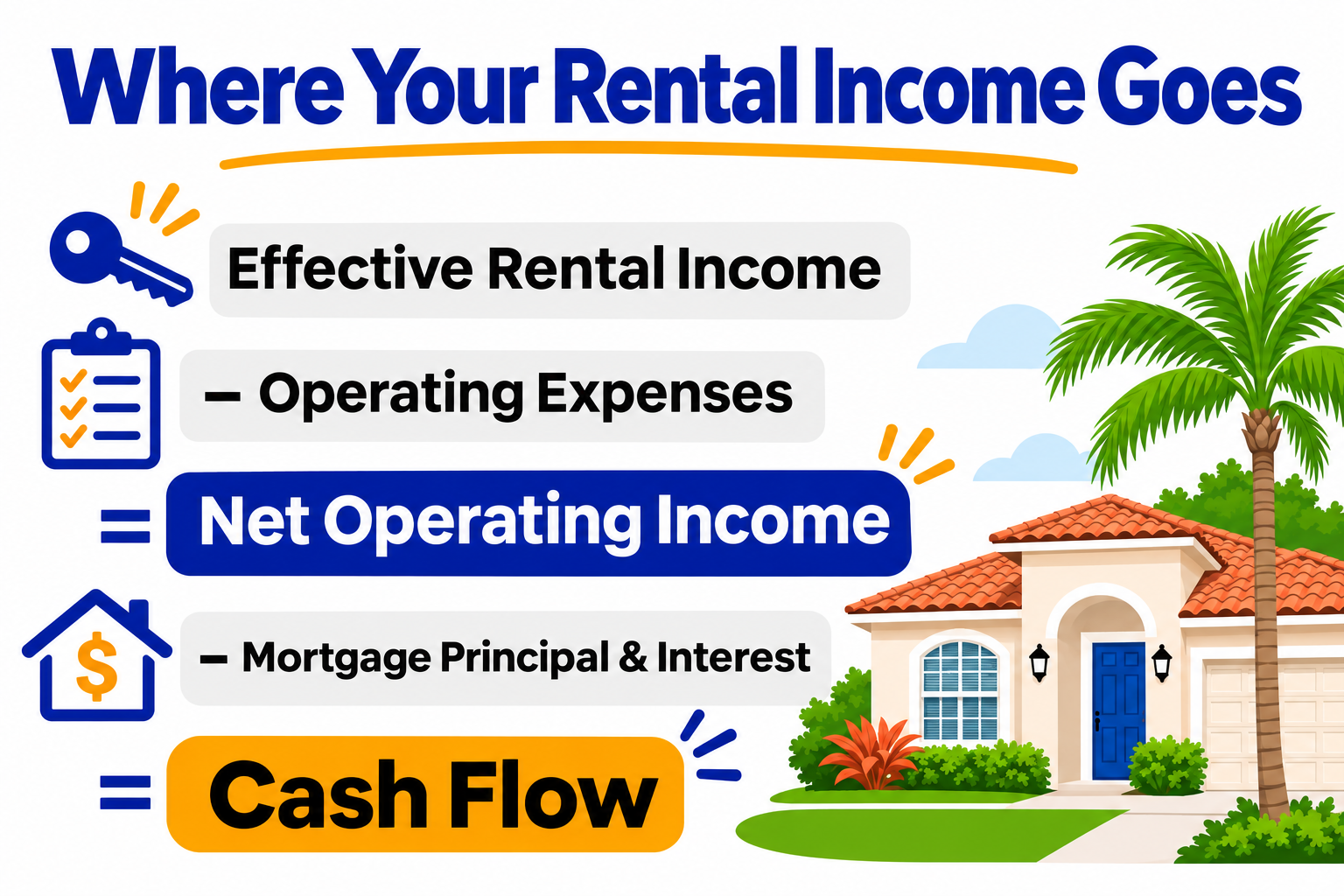
Mortgage debt service includes both principal and interest payments.
A property generating positive cash flow provides income after these costs. Negative cash flow means you are contributing additional money to keep the property operating.
Cash-on-Cash Return
This measurement shows how much annual pre-tax cash flow you're earning relative to the actual cash you invested in the property.
Formula:
Cash-on-Cash Return = (Annual Pre-Tax Cash Flow ÷ Total Cash Invested) × 100
Your total cash invested may include your down payment, closing costs, initial renovations, and other acquisition expenses, along with subsequent capital contributions where applicable.
Capitalization Rate (Cap Rate)
Cap rate helps you evaluate a property's income-producing potential relative to its current market value.
Formula:
Cap Rate = (Annual NOI ÷ Current Market Value) × 100
Unlike cash-on-cash return, cap rate doesn't account for your financing structure. This makes it useful when comparing the income performance of different investment properties.
These measurements provide different perspectives on investment performance. For example, a property might have a strong cap rate but generate relatively little monthly cash flow because of its mortgage payments.
Also consider your loan amortization schedule. Although mortgage principal payments reduce your available cash flow, they gradually increase your ownership equity. Tracking principal reduction alongside cash flow gives you a more complete picture of your investment's financial performance.
Compare Rental Rates and Evaluate Local Market Demand
Your rental rate directly affects your property's income potential, but charging the highest possible rent isn't always the best strategy.
If your rent is too low, you could be leaving money on the table. If it’s too high, you risk longer vacancies, fewer qualified applicants, and additional carrying costs.
Research comparable rental properties in your neighborhood. Look at:
- Monthly rental rates for homes with similar sizes, layouts, and features.
- Amenities and upgrades offered by competing properties.
- How long comparable homes remain available before leasing.
- Recently leased properties and verified rental rates.
- The number of competing rentals in your immediate market.
Whenever possible, use verified lease information and local market data rather than relying on advertised asking rents. Strong tenant demand gives you room to adjust rents, while increasing vacancy periods or growing rental inventory may indicate that you need to reconsider your pricing strategy.
Review Maintenance Costs and Plan for Capital Improvements
Every rental property ages, and maintenance is an unavoidable part of ownership. The challenge is knowing when to repair an existing item and when replacing it makes better financial sense.
Deferred maintenance, like a leaky faucet that gets ignored or a furnace pushed through one more winter, tends to turn into an expensive emergency later. And sometimes spending money to replace a higher ticket item, like an HVAC system or refrigerator, is better than repairs.
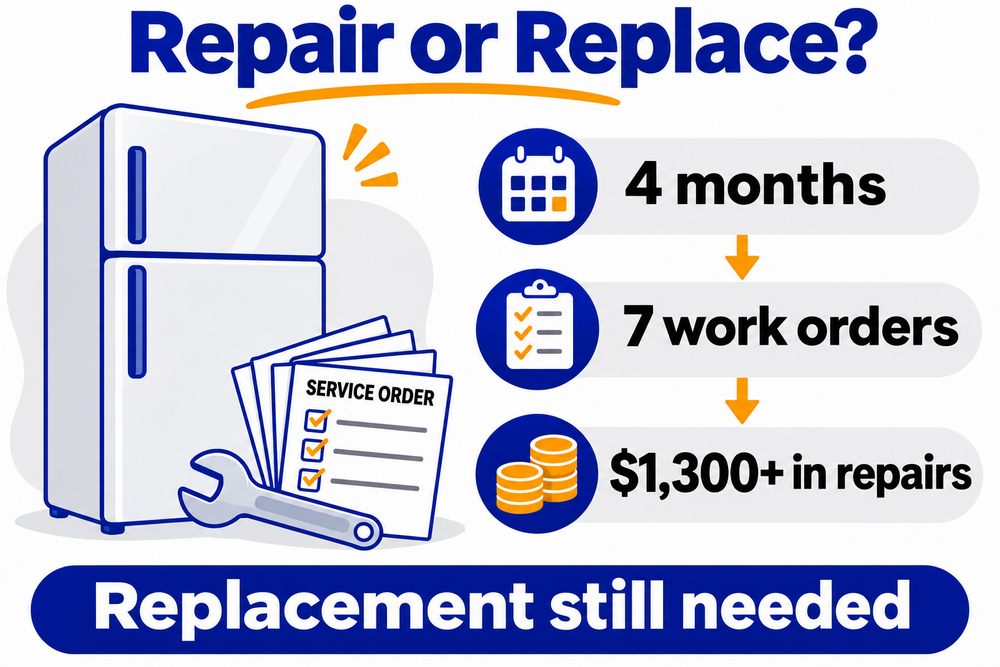
One owner recently repaired a 12-year-old refrigerator because it was “a $2,000 unit,” despite a vendor’s recommendation. Four months, seven work orders, and more than $1,300 later, the unit still was not working properly. The end result created tenant frustration, potential turnover costs, and the need to replace it anyway.
Unexpected repairs are part of ownership, so setting aside a reserve each month softens the blow.
Plan for Insurance Costs
Insurance costs deserve the same attention. Even as some Florida carriers reduce rates, an individual landlord’s renewal can still rise because of higher dwelling coverage, lapsed wind-mitigation discounts, or roof age. Read more about Florida insurance rate cuts.
Invest Where It Matters
Capital improvements such as new flooring, energy-efficient windows, or updated bathrooms cost more up front but can boost tenant satisfaction, justify higher rents, and increase long-term appreciation.
Our guide to proactive rental home maintenance explains how preventative care can help property owners avoid expensive emergencies.
Evaluate Tenant Retention and Vacancy Costs
A reliable tenant who renews their lease can be one of the most valuable contributors to your rental property's performance.
Every turnover brings cleaning, repairs, marketing, showings, and weeks of lost rent while the unit sits empty, and leasing delays add up quickly.
Consider the following ways to encourage lease renewals:
- Respond promptly to maintenance requests.
- Keep the property clean, safe, and well-maintained.
- Communicate clearly and consistently with tenants.
- Make reasonable, market-informed rent adjustments.
- Address recurring tenant concerns before they become reasons to leave.
A slightly lower rent increase that encourages a good tenant to renew may be more financially beneficial than pushing rent too high and facing an expensive turnover.
Monitor Local Market Conditions and Future Appreciation
Your rental property’s future value depends heavily on what’s happening in the surrounding neighborhood.
Pay attention to indicators such as:
- Population growth: An increase in residents can create additional demand for housing.
- Employment opportunities: New businesses and major employers may attract renters and potential homebuyers.
- Infrastructure improvements: New roads, public transportation, schools, and community facilities can improve neighborhood accessibility and appeal.
- Neighborhood development: New businesses, commercial developments, and residential improvements can contribute to local growth.
- Rental housing supply: An increase in competing rental properties can put pressure on rental rates and occupancy.
However, development doesn't automatically guarantee appreciation. New construction may also introduce more competition, while economic changes can affect affordability and demand.
Evaluate Property Management and Investment Protection
Whether you self-manage or hire a professional, good management protects your investment.
Good property management isn't just about collecting rent. It involves protecting the property's condition, maintaining tenant relationships, controlling expenses, and minimizing unnecessary vacancies.
Evaluate your current management arrangement by asking:
- Do you receive clear and consistent financial reports?
- Are maintenance concerns addressed promptly?
- Are repairs evaluated based on long-term cost and value?
- Are rental rates reviewed against current market conditions?
- Are tenant communications and lease renewals handled effectively?
- Are expenses transparent and properly documented?
- Are vacancies and turnover costs being monitored?
If you're constantly dealing with unexpected expenses, recurring maintenance issues, or prolonged vacancies, your management strategy may need attention.
Self-management can appear less expensive because you avoid professional management fees. However, the time spent coordinating repairs, handling tenant concerns, marketing vacancies, and managing lease compliance also has a cost.
Compare the Financial Benefits of Holding vs. Selling
At some point, every rental property owner asks should I keep it or sell it?
The answer shouldn't depend on market conditions alone. It should also reflect your property's current performance, future potential, financial obligations, and personal investment goals.
Before making a decision, compare the following.
Reasons to Consider Holding
- Your property generates consistent positive cash flow.
- Rental demand remains strong in the surrounding area.
- You expect reasonable long-term appreciation.
- Mortgage principal payments continue building equity.
- Upcoming maintenance costs are manageable.
- The property supports your broader investment strategy.
Reasons to Consider Selling
- Operating expenses and mortgage obligations consistently outweigh rental income.
- Major repairs or replacements are approaching.
- Your property's value and available equity make selling financially attractive.
- Rental demand is weakening or vacancy periods are increasing.
- Your equity could be put to better use elsewhere.
- The property no longer aligns with your financial goals.
Still weighing whether to keep your Central Florida rental or sell it?
Use our Rent vs. Sell Calculator to compare the financial outcomes side by side using your property’s numbers.
Track Your Rental Property's Long-Term Investment Performance
Evaluating your rental property shouldn't be a one-time exercise. Regular reviews help you recognize changes in performance and make informed decisions before small problems become expensive ones.
At least once a year, review the following:
- Current estimated property value and accumulated equity.
- Rental income and changes in market rental rates.
- Operating expenses and annual cash flow.
- Cash-on-cash return and capitalization rate.
- Maintenance costs and upcoming capital improvements.
- Vacancy periods and tenant retention.
- Local real estate trends and investment opportunities.
A simple spreadsheet can help you organize these numbers and compare performance from year to year.
You can also use your annual review to set specific financial goals, such as improving cash flow, reducing maintenance expenses, increasing tenant retention, or preparing the property for a potential sale.
The more consistently you track your numbers, the easier it becomes to identify whether your rental property is meeting expectations.
The Bottom Line
A rental property can be a powerful wealth-building tool, but only when you understand how it's actually performing.
Looking beyond monthly rent to evaluate cash flow, operating expenses, market value, tenant retention, and long-term appreciation gives you a more complete picture of your investment.
For Central Florida property owners and investors, regularly reviewing these factors can help identify opportunities, address potential problems, and make informed decisions about whether to hold, improve, or sell a property.
And if managing all these moving parts becomes overwhelming, working with an experienced property management team can help you stay on top of your investment while keeping your long-term financial goals in focus.
The Realty Medics helps Central Florida rental property owners protect their investments through proactive property management, maintenance coordination, and local market expertise.
Frequently Asked Questions
What’s The Realty Medics’ role as a property manager?
Our role is to engineer the best possible experience for our owners. That means generating steady income for you while preserving or increasing the value of your investment property. Our specific tasks include advertising your property, screening tenants, negotiating leases, collecting rent, scheduling maintenance for your property, keeping accurate records and providing regular reports and communication.
What’s your philosophy of property management?
We want to make Central Florida the best place to live because it’s the best place to rent. That means engineering a positive rental experience based on maximizing ROI for owners while maintaining quality housing for tenants. We do this by building strong relationships, using the latest technology, implementing effective marketing strategies, staying on top of industry trends, and following consistent systems—all with honesty and integrity.
What expectations do you have for leasable properties?
Before we offer a property for lease, we thoroughly inspect it to ensure compliance with all governmental ordinances. We also advise our clients with recommendations to maximize their return on investment. By offering a quality product, we work hard to minimize maintenance requests and complaints while maximizing resident retention and satisfaction.
How much can my investment property lease for?
Several factors determine your lease rate, including rental rates for competing homes in the immediate area, as well as your property’s location and condition. Since we have more than 1000 rental properties in Central Florida, we have internal market data as well as having a rental home in most neighborhoods in our area. We will be happy to provide you with a Free Rental Price Analysis report with the best possible pricing.